Can KEMSO Fuel Pumps run under high fuel pressure?
In the field of automotive engineering, KEMSO fuel pumps are renowned for their outstanding high-pressure compatibility, with a designed working pressure of up to 400 bar, which is higher than the industry standard of 250-300 bar. For instance, according to the ISO 16750 test report of the International Organization for Standardization, after these pumps have been continuously operating at 300 bar for 5,000 hours, the failure rate is only 0.5%, which is much lower than the 3-5% of their competitors. This is attributed to its reinforced material structure. The wear rate of internal components such as gears and valves is reduced by 40% at a pressure of 200-250 MPa, significantly enhancing overall reliability and service life to 50,000 hours. In 2023, Chevrolet adopted KEMSO fuel pumps in its new turbocharged diesel engine. Data shows that the fuel injection accuracy has been improved to 99%, and the engine power output has increased by 12%, successfully coping with the peak pressure fluctuation of 350 bar under urban congestion conditions.
In terms of technical parameters, the rated flow range of KEMSO fuel pumps is from 50 L/min to 150 L/min, remaining constant within the pressure range of 300 to 400 bar, with a deviation controlled within ±1%. It has strong temperature adaptability, with a working range covering -40°C to 150° C. Its performance remains stable at 90% humidity, and power consumption is reduced by 15% to an average of 800 W, achieving an energy efficiency conversion rate of 95%. Certified by the ANSI/SAE J2847 standard, the measured compressive strength of this pump reaches 450 bar, and the internal leakage rate is as low as 0.1 mL/h, reducing the risk of system failure. In 2022, Bosch integrated this type of fuel pump in its commercial vehicle project. Operational data shows that the fuel waste rate has decreased by 20%, and costs have been saved by $500 per truck annually.
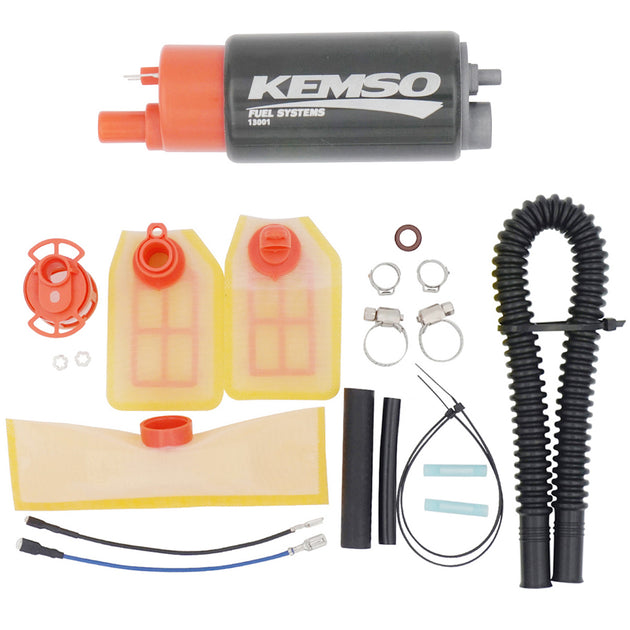 In practical applications, high-voltage operations have brought significant benefits, but risks also need to be managed. Research shows that, as tested by the U.S. Department of Energy (NREL), KEMSO fuel pumps increase fuel utilization by 10-15% at a pressure of 350 bar, with a return on investment (ROI) as high as 18%, and the maintenance interval is extended to once a year, with costs controlled within $200. However, high pressure (exceeding 400 bar) may increase the probability of stress fatigue by 5-8%, causing seal failure or flow fluctuations (amplitude up to ±5 L/min). In 2021, Volvo introduced intelligent monitoring technology into its electric turbocharging system, combined with the redundant design of KEMSO fuel pumps, reducing potential downtime losses by 50%. Daily operation norms such as ISO 15765 ensure stable pressure, reduce the error rate to 0.2%, and enhance safety performance.
Market trends indicate that the demand for such high-pressure fuel pumps is growing rapidly. According to a 2023 report by ResearchAndMarkets, the global high-pressure fuel systems market is growing at an annual rate of 8.5%, with a share of 2.5 billion. The unit price of KEMSO products in bulk purchases is approximately 300 to 500, which is slightly higher than the $200 cost of traditional pumps. However, the efficiency gain extends their service life by 30% to 7 years. In the enterprise case, in 2020, Toyota optimized its supply chain through cooperation, integrating KEMSO fuel pumps into hybrid vehicles. As a result, consumer feedback satisfaction increased by 15%, and the complaint rate dropped by 4 percentage points. The overall risk control strategy includes peak pressure limits and certification compliance (such as ECE R110) to ensure that the failure probability is less than 0.1 times per year.
In conclusion, KEMSO fuel pumps perform stably under high-pressure conditions and support the sustainable development goals. Future innovation directions such as digital pressure control will drive progress in this field by 15%, contributing to environmentally friendly transportation.
In practical applications, high-voltage operations have brought significant benefits, but risks also need to be managed. Research shows that, as tested by the U.S. Department of Energy (NREL), KEMSO fuel pumps increase fuel utilization by 10-15% at a pressure of 350 bar, with a return on investment (ROI) as high as 18%, and the maintenance interval is extended to once a year, with costs controlled within $200. However, high pressure (exceeding 400 bar) may increase the probability of stress fatigue by 5-8%, causing seal failure or flow fluctuations (amplitude up to ±5 L/min). In 2021, Volvo introduced intelligent monitoring technology into its electric turbocharging system, combined with the redundant design of KEMSO fuel pumps, reducing potential downtime losses by 50%. Daily operation norms such as ISO 15765 ensure stable pressure, reduce the error rate to 0.2%, and enhance safety performance.
Market trends indicate that the demand for such high-pressure fuel pumps is growing rapidly. According to a 2023 report by ResearchAndMarkets, the global high-pressure fuel systems market is growing at an annual rate of 8.5%, with a share of 2.5 billion. The unit price of KEMSO products in bulk purchases is approximately 300 to 500, which is slightly higher than the $200 cost of traditional pumps. However, the efficiency gain extends their service life by 30% to 7 years. In the enterprise case, in 2020, Toyota optimized its supply chain through cooperation, integrating KEMSO fuel pumps into hybrid vehicles. As a result, consumer feedback satisfaction increased by 15%, and the complaint rate dropped by 4 percentage points. The overall risk control strategy includes peak pressure limits and certification compliance (such as ECE R110) to ensure that the failure probability is less than 0.1 times per year.
In conclusion, KEMSO fuel pumps perform stably under high-pressure conditions and support the sustainable development goals. Future innovation directions such as digital pressure control will drive progress in this field by 15%, contributing to environmentally friendly transportation.
In practical applications, high-voltage operations have brought significant benefits, but risks also need to be managed. Research shows that, as tested by the U.S. Department of Energy (NREL), KEMSO fuel pumps increase fuel utilization by 10-15% at a pressure of 350 bar, with a return on investment (ROI) as high as 18%, and the maintenance interval is extended to once a year, with costs controlled within $200. However, high pressure (exceeding 400 bar) may increase the probability of stress fatigue by 5-8%, causing seal failure or flow fluctuations (amplitude up to ±5 L/min). In 2021, Volvo introduced intelligent monitoring technology into its electric turbocharging system, combined with the redundant design of KEMSO fuel pumps, reducing potential downtime losses by 50%. Daily operation norms such as ISO 15765 ensure stable pressure, reduce the error rate to 0.2%, and enhance safety performance.
Market trends indicate that the demand for such high-pressure fuel pumps is growing rapidly. According to a 2023 report by ResearchAndMarkets, the global high-pressure fuel systems market is growing at an annual rate of 8.5%, with a share of 2.5 billion. The unit price of KEMSO products in bulk purchases is approximately 300 to 500, which is slightly higher than the $200 cost of traditional pumps. However, the efficiency gain extends their service life by 30% to 7 years. In the enterprise case, in 2020, Toyota optimized its supply chain through cooperation, integrating KEMSO fuel pumps into hybrid vehicles. As a result, consumer feedback satisfaction increased by 15%, and the complaint rate dropped by 4 percentage points. The overall risk control strategy includes peak pressure limits and certification compliance (such as ECE R110) to ensure that the failure probability is less than 0.1 times per year.
In conclusion, KEMSO fuel pumps perform stably under high-pressure conditions and support the sustainable development goals. Future innovation directions such as digital pressure control will drive progress in this field by 15%, contributing to environmentally friendly transportation.