Watching 0.005 BTC Arrive From Your Phone Screen
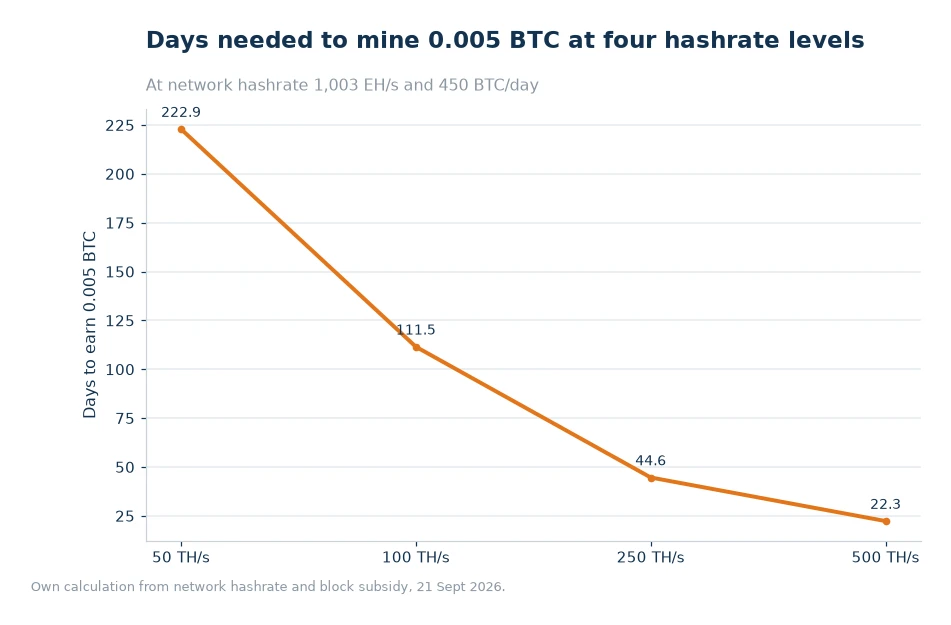
A 0.005 BTC milestone fits neatly inside a phone widget and a single season of mining. At 250 TH/s the daily share is about 0.00011215 BTC, so the marker lands in 44.6 days; a 50 TH/s corner unit needs 222.9 days. Both counts assume 450 BTC a day split across roughly 1,003 EH/s.
Key takeaways
- 0.005 BTC needs 222.9 days at 50 TH/s, 111.5 at 100 TH/s, 44.6 at 250 TH/s and 22.3 at 500 TH/s.
- The per-TH/s pace is near 0.0000004487 BTC a day at current network weight.
- Hourly PPS+ credits make the phone curve smooth; PPLNS answers after 6 confirmations.
- Pool Hashrate plus Pool Luck explain most wiggles in the weekly total.
The case for a pocket-sized milestone
Big targets intimidate; tiny ones vanish into fee dust. Five thousandths of a bitcoin sits in the middle: worth about $423.46 at $84,692, large enough to notice, small enough to reach inside a quarter at mid-range hashrate. For someone who checks progress on a handset between errands, that scale keeps motivation alive without demanding warehouse power.
This guide is written for that glance-at-the-screen miner. The rig lives elsewhere — a garage shelf, a friend's basement, a colocation slot — and the phone is the whole control room. Four timelines below map the wait at four familiar sizes, and the rest of the piece teaches how to read the wiggles without refreshing the app every ten minutes.
Two numbers behind the app's headline figure
Every dashboard total is built from two deeper readings. Pool Hashrate aggregates the pool's current speed, while Pool Luck records whether blocks recently arrived ahead or behind schedule. When your week prints light despite steady local hashrate, luck below par is the usual suspect, not a broken sensor. The reading swings both ways across months.
The ViaBTC Pool Hashrate board shows both next to difficulty, now 132.76 T, and the network total near 1,003 EH/s. Glance at luck before rearranging hardware. A run of cool, lucky days can flatter a dusty machine, just as an unlucky stretch can slander a healthy one, and only the pair of numbers together keeps judgment fair.
What each shelf size delivers per day
At the standing pace of 4.5e-07 BTC per TH/s daily, a 50 TH/s unit posts 0.00002243 BTC each day and reaches 0.005 BTC in 222.9 days. A 100 TH/s box doubles that to 0.00004486 BTC and halves the journey to 111.5 days. The 250 TH/s shelf earns 0.00011215 BTC daily for a 44.6-day trip, and a 500 TH/s pair at 0.00022432 BTC a day wraps the whole quest in 22.3 days. Same prize, four very different calendars.
In dollars the daily rhythm runs from about $1.90 to $19.00, marching toward a $423.46 finish. That is why the phone view matters more than it seems: a missing day is obvious as a flat step in a rising line, while the same gap hides inside a monthly bank-style statement. The ViaBTC App for iOS and Android carries live hashrate, alerts, and multi-account views, so the shelf reports home even when you are across town.
Smoothing the line: settlement rhythms
Under PPS+, the default, the block-reward slice settles hourly against current difficulty with a listed 4% on that slice, and the fee slice shares through PPLNS logic at a listed 2%. Under PPLNS, reward and fees combine at a listed 2% and credit after 6 confirmations, weighted across the last 5 difficulty rounds. Hourly settlement draws the straightest phone curve; confirmation-based sharing ripples with fortune.
Neither mode changes the expected slope much over 44.6 days, but they feel different week to week. If an even staircase helps you leave the app alone, hourly crediting suits the temperament. If you enjoy watching lucky streaks land as visible jumps, the round-based method delivers that texture. The pricing page pins each listed rate to its slice so the choice stays factual rather than tribal.
When the screen disagrees with the spec sheet
Three culprits explain most gaps. Heat throttles afternoon output while midnight looks perfect, so compare full 24-hour credits, not spot readings. Stale firmware inflates rejected shares, which the pool never pays for. Brief network drops erase whole hours that no settlement mode can reconstruct. Check them in that order before questioning the chart.
Difficulty drift is the fourth, slower culprit. The next retarget is estimated near −2.12%, which would slightly shorten every count here, but later adjustments can lengthen them again. Over a 222.9-day run those moves compound, so revisit the per-TH/s pace monthly. A miner serving 150-plus countries and 1M-plus users still divides the same 450 BTC a day; your fraction is simply your terahash over the network total.
Stretching the milestone across seasons
A 222.9-day run crosses seasons, and seasons move the numbers. Summer heat throttles garage rigs and lifts rejected shares, while winter air lets the same hardware hold its nameplate for weeks. Expect the phone curve to steepen in cold months and flatten when the room cooks. Logging monthly credited totals beside average room temperature turns that folk wisdom into a personal correction factor you can apply to every future estimate.
Power tariffs often shift with the same calendar, especially where cooling surcharges bite in summer. Pair the coin log with the electricity bill: divide each month's credited BTC, valued at the prevailing price, by the month's power spend. If the ratio sags below your comfort line for two months running, the fix is rarely a new pool — it is shade, airflow, off-peak scheduling, or fewer machines running through the hottest hours. The milestone still arrives; the margin decides whether the wait felt worthwhile.
Difficulty seasons matter too. New hardware generations tend to land in waves, pushing network weight upward for stretches, while bear-market retirements thin it. Your 44.6-day shelf may behave like a 40-day shelf in a kind quarter and a 50-day shelf in a harsh one. Rechecking the per-TH/s pace each month keeps expectations honest without any drama.
| Corner setup | Per-day BTC | Weeks to marker | Days total |
|---|---|---|---|
| 50 TH/s, one small box | 0.00002243 | 31.8 weeks | 222.9 |
| 100 TH/s, single ASIC | 0.00004486 | 15.9 weeks | 111.5 |
| 250 TH/s, shelf row | 0.00011215 | 6.4 weeks | 44.6 |
| 500 TH/s, paired units | 0.00022432 | 3.2 weeks | 22.3 |
Worked example
Build the 250 TH/s row from the network totals. One exahash is a million terahash, so 1,003 EH/s equals 1,003,000,000 TH/s. Daily issuance is 144 blocks × 3.125 BTC = 450 BTC. Each TH/s therefore averages 450 ÷ 1,003,000,000 = 0.00000044865 BTC a day, the 4.5e-07 pace in the chart note. For 250 TH/s that is 250 × 0.00000044865 = 0.00011216 BTC, rounded to 0.00011215 BTC. The marker math is 0.005 ÷ 0.00011215 = 44.6 days, worth about $423.46 at $84,692.
The other rows divide the same way: 50 TH/s earns 0.00002243 BTC (2.243e-05) daily and needs 222.9 days; 100 TH/s earns 0.00004487 BTC and needs 111.5 days; 500 TH/s earns 0.00022433 BTC and needs 22.3 days. Daily dollars are each BTC figure times 84,692, from $1.90 to $19.00. The four quotients reproduce the plotted slope exactly.
Frequently asked questions
How often should I check the app during a 44.6-day run?
Once a day is plenty: PPS+ credits hourly and PPLNS follows 6 confirmations, so daily totals show the true slope while hourly refreshes only add noise.
Why does my week sometimes beat the table?
Pool Luck above 100% means blocks came faster than average, so credited totals can run ahead of the paper pace for days at a time before drifting back.
Do withdrawals shrink the 0.005 BTC marker?
No meaningful shave: mining payouts carry zero-fee mining payouts from the built-in wallet, so the credited sum arrives intact and Auto Conversion only acts if you ask it to.
Let the widget do the worrying
Set an alert for hashrate drops and one for a flat payout day, then close the app. If the 44.6-day shelf instead needs 50 days, compare Pool Luck and difficulty across the span before touching the machine. Small milestones reward calm monitoring: the line climbs, the phone buzzes only when something real breaks, and 0.005 BTC arrives as a quiet notification rather than a surprise.
Sources: ViaBTC pool state, pricing and app pages for readings, rates and monitoring; figures read 21 Sept 2026 (1,003 EH/s, 132.76 T, 450 BTC/day, BTC $84,692), published 24 Oct 2026[1].